
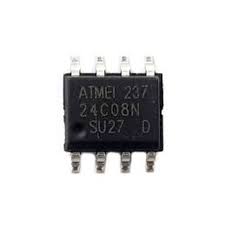
Detailed Description
The 24C08N / AT24C08 EEPROM is a small, non-volatile memory chip that offers 8 Kbit (1,024 × 8 bits) of persistent storage using a classic I²C (two-wire) serial interface. This makes it a versatile choice for embedded systems, microcontrollers, and any electronics project that requires a compact memory solution for storing configuration data, calibration values, or small logs.
Designed for low-power operation, the 24C08N supports a broad supply voltage range (depending on variant) and includes a Write Protect (WP) pin, allowing you to lock the memory region to prevent further writes when your data is finalized. The memory supports page write mode, which enables up to 16 bytes to be written in a single write cycle, improving efficiency and reducing I²C bus utilization.
With a self-timed internal write cycle (typically a few milliseconds) and a high endurance rating (around 1,000,000 write cycles), this EEPROM is built to last. Data retention is rated in decades, making the 24C08N ideal for long-term storage of critical parameters. It also includes Schmitt-triggered inputs to filter out noise and provide stable I²C communication.
Key Features
-
8 Kbit memory capacity (1,024 × 8-bit structure)
-
I²C / 2-wire serial communication interface
-
Page write capability (up to 16 bytes at once)
-
Write Protect pin for hardware-level memory locking
-
Self-timed internal write cycle (typically a few ms)
-
High endurance (≈ 1,000,000 write cycles)
-
Long data retention (many years)
-
Low active and standby current consumption
-
On-chip Schmitt trigger input for better noise immunity
-
Wide operating voltage (depends on manufacturer / part variant)
Technical Specifications
-
Memory Organization: 1,024 × 8 bits
-
Interface: I²C (SDA, SCL)
-
Typical Write Cycle Time: ~4–5 ms (self-timed)
-
Page Size: 16 bytes per write
-
Endurance: ~1 million erase/write cycles
-
Data Retention: On the order of decades
-
Operating Voltage: Varies by variant (commonly around 1.7 V – 5.5 V depending on part)
-
Clock Speed (I²C): Supports standard and fast I²C modes (manufacturer dependent)
-
Operating Temperature Range: Varies by part family (check specific datasheet for details)
-
Package Options: SOIC-8, DIP-8, and other common IC packages
Typical Applications
-
Storing configuration or calibration data for microcontroller-based systems
-
Saving device settings and parameters that must persist across power cycles
-
Logging small amounts of data (e.g., usage counters, error logs)
-
Non-volatile memory for wearable devices, sensors, or IoT modules
-
Memory for bootloaders and firmware metadata
-
Parameter storage in industrial and consumer electronics
Benefits
-
Reliable non-volatile storage that retains data even when power is removed
-
Low power usage — suitable for battery-powered devices
-
Compact and easy to place on a PCB with limited space
-
Simple I²C interface — compatible with most microcontrollers
-
High write endurance enables frequent updates to stored data
-
Write protection adds a layer of data safety
-
Efficient page write reduces I²C traffic and speeds up write operations
Usage Notes
-
After initiating a write, allow time for the internal write cycle to complete (typically a few milliseconds) before issuing another command.
-
Use the WP (Write Protect) pin if you want to prevent accidental writes once your memory is finalized.
-
Use page-write mode when writing more than one byte — this is more efficient and faster than byte-wise write.
-
Make sure to use pull-up resistors on the I²C lines (SDA and SCL) appropriate for your operating voltage.
-
Choose the correct I²C address bits, if supported, to avoid conflicts on your I²C bus.
-
For critical applications, consider verifying memory contents on startup and periodically.
Reviews
There are no reviews yet.